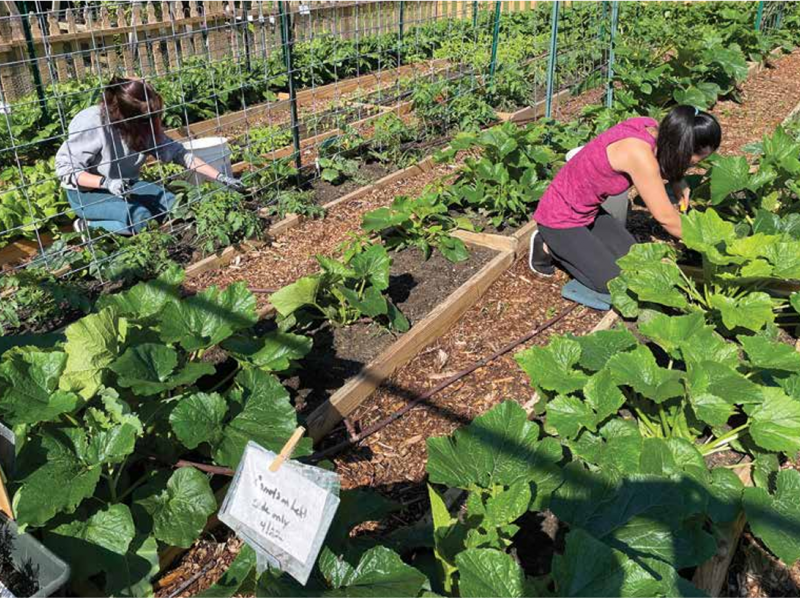
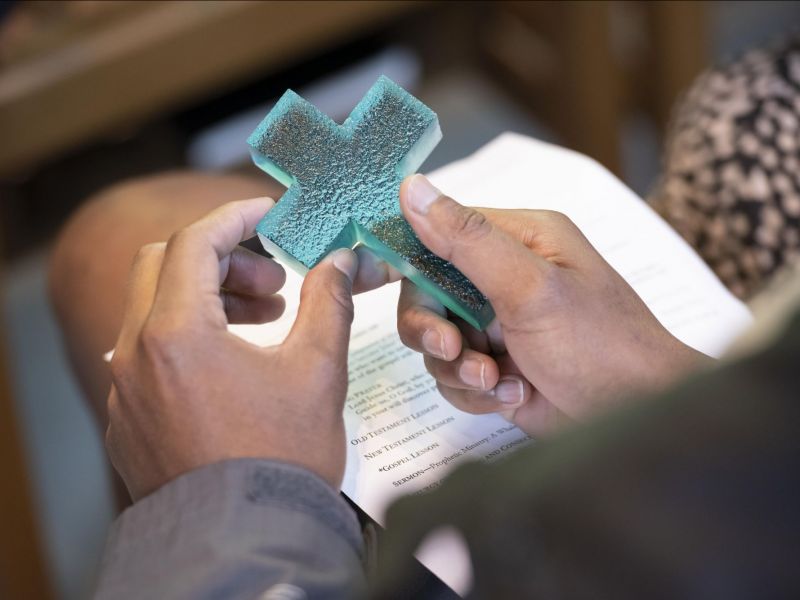
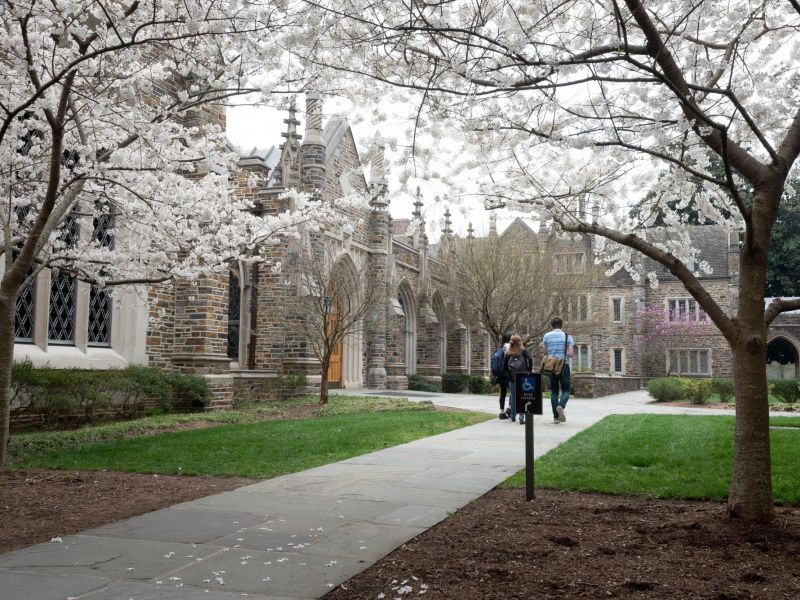
The M.Div./M.E.M. or M.F. dual-degree program is designed to prepare individuals to serve at the intersection of religion and environmental issues in the form of leadership, service, and advocacy within ministerial, nonprofit, government, and private sectors.
This program can be completed in four continuous years of full-time study (instead of five years) and leads to a Master of Divinity degree at Duke Divinity School and to either a Master of Environmental Management or Master of Forestry degree from Duke University’s Nicholas School of the Environment. This dual-degree option is only available to residential M.Div. students.
The M.Div. degree at the Divinity School trains students to be Christian ministers and leaders in a variety of settings. Fifty-seven percent of M.Div. graduates choose church-based ministry, while 43% choose positions in nonprofit organizations, chaplaincy, education, or further graduate work. The M.Div. boasts an academically rigorous curriculum surrounded by vibrant worship, contextual learning, opportunities for spiritual formation, and a close-knit student community.
The Master of Environmental Management from the Nicholas School of the Environment is structured to provide expertise in an environmental topical area (in the form of an environment concentration) and to aid in the implementation of that topical area in various professional settings (in the form of a management concentration). The Master of Forestry from the Nicholas School of the Environment is accredited by the Society of American Foresters and is a credential for those seeking to serve as foresters at the edges of forest management, conservation, and policy. Through this degree, students are exposed to four core competencies, and within these they can seek an emphasis on particular resources or analytic approaches.
Top Tier Faculty
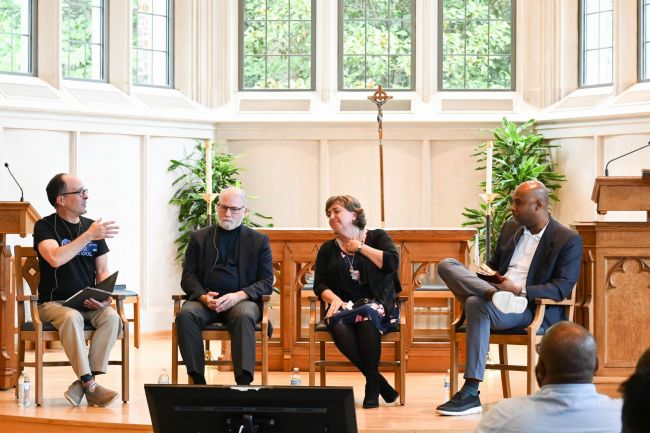
Our faculty are at the pinnacle of their fields of study, and their work is at the cutting edge of research. Students benefit by studying directly with academics who are not only the best at what they do but dedicated to the church and to nurturing the next generation of pastors, thinkers, and doers of theology.
Practical Experiences
Duke Divinity is unique in its ability to provide funding for up to three field education internships (two placements are required for graduation). Placements can be in nonprofit settings, churches, and include international opportunities
Curriculum
The curriculum for our M.Div. degree program is designed to give students a solid foundation for wherever their calling takes them—be that ordination, lay ministry, nonprofit work, or a career in teaching. Our classes cover Old and New Testament, church history, Christian theology, world Christianity, ministry, worship, preaching, biblical languages, the Black Church, and a variety of electives.
The M.E.M. program at Duke’s Nicholas School of the Environment is for students who want to make an impact in meaningful careers at the intersection of environmental policy, science, and community. Students choose one concentration in a topical area (Environment Concentration) and a second that will provide skills to put this knowledge into practice (Management Concentration). The M.F. program at Duke’s Nicholas School of the Environment seeks to instill in students a foundation of sound, structured theory coupled with practical forest management skills. This is achieved through a curricular focus on four core competencies: forest ecology and biology, measurement of forest resources, silviculture and management of forest resources, and forest resources policy, economics, and administration.
Those interested in dual-degree programs are required to pursue admission to each school independently, and upon successful admission to both programs, are enrolled as dual-degree students.
The core curriculum of each degree must be completed at each institution. Students take the first two years at the Divinity School, the third year at the Nicholas School, and the fourth year with blended coursework from both schools.
Graduation Requirements
M.Div.
- Twenty Divinity School courses (this number is reduced as part of the dual degree status)
- Two student portfolios (middler and senior)
- Two approved units of field education
M.E.M.
- Students must select an Environment Concentration (4 courses/12 credits) and a Management Concentration (4 courses/12 credits)
- Master’s Project
- Seminar
M.F.
- Students will focus on Forest Resource Management
- In Competency Areas: Forest Ecology and Biology (6 credits), Measurement of Forest Resources (6 credits), Silviculture and Management of Forest Resources (8.5 credits), and Forest Resources Policy, Economics, and Administration (7.5 credits)
- Capstone Course
- Seminar
Center for Writing and Academic Support
The Center for Writing and Academic Support provides services for writers of all abilities. In addition, we offer the RISE pre-orientation workshop to introduce the fundamentals of theological thought and writing; ongoing academic support workshops throughout the year; and tutors who are available to work with students one-on-one.

An education from Duke Divinity School is worth your investment, and you do not have to figure out the finances alone.
All M.Div. students receive funding.
Duke Divinity School is investing in you, too. It is an investment in your education, the church, and our shared future. All M.Div. students receive some form of scholarship support from Duke Divinity School that will cover between 25% and 100% of tuition costs, and there is no separate application needed in order to be considered. The M.Div. program offers many fellowships that also provide tuition support. Many other internal and external scholarships, as well as federal financial aid in the form of work study and loans, make it possible for students to afford Duke Divinity. We are committed to ensuring that every student who hears the call to ministry can fund their education here. FAFSA should be completed for external aid. More information can be found in our Financial Aid section.
Lifelong Dividends
In addition to earning a degree from Duke Divinity School, you also receive benefits that continue to impact your life long after you leave. You will have access to the best academic resources in theological education and will use those tools throughout your career. Theses that are crafted with Duke Divinity faculty members become seeds that may grow into future doctoral projects. By being able to fully participate in a top tier research university, your scholarship can create room for surprising and creative interdisciplinary connections. The overwhelming majority of our students say their investment is worth it.
Ready for the Next Step?
Those interested in dual-degree programs are required to pursue admission to each school independently, and upon successful admission to both programs, are enrolled as dual-degree students.
Duke Divinity School accepts applications from students with a demonstrated commitment to some form of ordained or lay ministry and a minimum GPA of 2.75 in a bachelor’s degree from a regionally accredited college or university prior to the intended date of enrollment.
M.Div. Application Requirements
Apply to the M.E.M. or M.F.
The application deadline for the Master of Environmental Management and the Master of Forestry is December 15.
Request Info
Join our mailing list, and we'll send you more information.
Request Info about our programsVisit Campus
The best way to learn more about us is to visit. Schedule an in-person or online visit.
Visit Us