
Online
For Alumni
For Clergy
For Lay Leaders
For Prospective Students
For Students
General Audience
Credit Offered
Drs. Natalie Carnes and Brewer Eberly discuss how beauty has been among the Christian names for God and why beauty, like suffering, is so central to the Christian story. What do these two parts of our existence—beauty and suffering—have to do with one another? And how can their togetherness help us love and attend in the strange world of medicine?

Natalie Carnes, PhD
Natalie Carnes is a constructive theologian invested in questions that cross the fields of aesthetics, feminism, and systematics. She has published several books, including Beauty: A Theological Engagement with Gregory of Nyssa (Cascade 2014), Image and Presence: A Christological Reflection on Iconoclasm and Iconophilia (Stanford 2017), Motherhood: A Confession (Stanford 2017), and most recently Attunement: The Art and Politics of Feminist Theology (OUP 2024). She is currently at work on a co-authored volume with Matthew Whelan on art and poverty, beginning a project on creativity that draws from psychological literature, and guest editing a special edition of Modern Theology. A graduate of Duke’s Ph.D. program (’11), she was previously professor of theology, affiliate faculty member in women’s and gender studies, and the director of the Baylor Initiative in Christianity and the Arts at Baylor University.
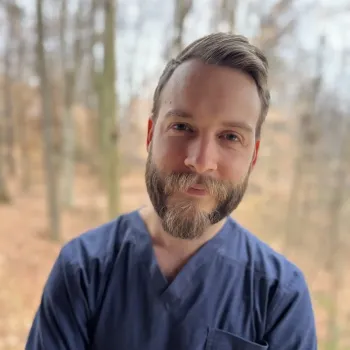
Brewer Eberly, MD, MACS
Brewer Eberly is a third-generation family physician working at Fischer Clinic in Raleigh, North Carolina. He completed his family medicine residency and chief residency at AnMed Health in Anderson, South Carolina. He is a McDonald Agape Fellow in the Theology, Medicine, and Culture Initiative at Duke Divinity School, having completed the Theology, Medicine, & Culture Fellowship as a medical student and the Paul Ramsey Institute Fellowship while in residency. He has been published widely, with pieces in JAMA, The New Atlantis, and CHEST, as well as in theological spaces like Christianity Today, First Things, and Plough. While the majority of his time is spent caring for his patients, his research is rooted in the intersections of medicine, aesthetics, and Christian theology, with a particular eye toward medical trainee formation, the relationship between beauty and ethics, and the nourishment of weary clinicians.