For Aamber Swann, her first day in a graduate school classroom gave her more than the usual start-of-school jitters. Sure, she was worried what others would think of her—would she be too nervous to put her thoughts together when she spoke, and would everyone think that she belonged there? But her fears went a little deeper: what would a group of Duke graduate students think of her, a woman incarcerated in the North Carolina Correctional Institution for Women (NCCIW), when they all began a course together through Project TURN?
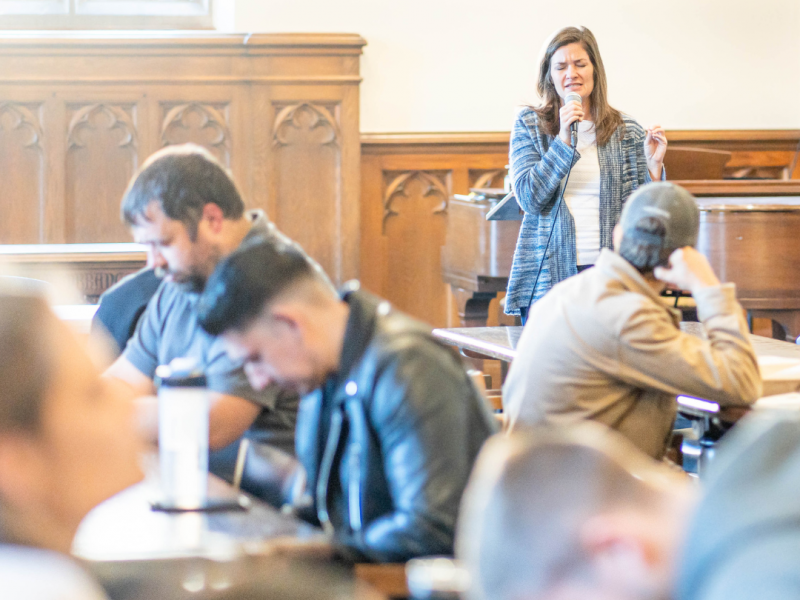
Project TURN (Transform, Unlock, ReNew) brings Duke Divinity School students and incarcerated students together to take graduate-level theology courses in a prison alongside each other, learning across race, class, and carceral divisions.
Each class includes around 10 residents from the hosting prison and 10 students from Duke Divinity School. The courses, taught by Divinity School faculty, include Christian theology, ethics, biblical studies, Christian history, pastoral care, and Christian discipleship.
Incarcerated students who complete five Project TURN courses earn a Certificate of Achievement in Theological Education.
We interviewed Swann and some of the other incarcerated students at NCCIW who have been involved in Project TURN.

Aamber Swann
What was it like to learn alongside Duke Divinity School students?
At first it was very intimidating and nerve-wracking. You know, I'm already a shy person, just in general, and I didn't know what they were going to think of me. I wasn't sure if I raised my hand, if my answers would be eloquent. But once I got in the classroom, I saw some of the outside students had the same nervous feelings. Then once things warmed up, I saw, oh, I belong here, and I have just as much of a voice as they do. And they're just as nervous.
In what ways did you feel heard by the Divinity School students and faculty?
I felt like they really paid attention to who each of us inside students were as individuals. And the staff of Duke Divinity School or students would come up to me and say, "Hey, I like what you said in class," or "I like your perspective." And it just amazed me that they cared so much and they were so enthusiastic. It was a pleasant surprise, and it really helped me to grow into that community.
Tell us about your favorite class.
One of my favorite classes was "The Poetic Imagination," because I already write poetry in my life. But it was awesome coming to poetry in a theological way. In ways that I've never thought to do. So it was very empowering for me, and I learned new skills. And also, we wrote a lot of poetry about nature, and I never really wrote poetry about nature. So coming across that new technique, it really helped me tap into a place inside myself that I didn't know was there.
Do you think you've gained any new perspectives from taking the Project Turn courses?
I look at my life in a deeper way. I ask more questions about what's going on. For an example of that, when I'm going through certain things in my life, I think about if this were a Duke Divinity class, what would it be named, what would be the subject, and what would I learn from that class? What does God have for me in that class? And it kind of helps me cope a little bit better with certain things going on in my life.
I speak up more, and I've gained deeper friendships with the inside people here. I've met a lot of incredible people from the outside, and it's just really been a big part of my spiritual journey.
What it was like learning from the Divinity School faculty?
It was amazing learning from the Duke faculty, because I felt like it made me feel like I wasn't in prison. And, you know, there are a lot of intelligent people in prison. So it felt good to be challenged. And we had to go deep in ourselves, and the teachers looked at both inside and outside students as just the same—they challenged all of us just the same and pushed us and saw that potential in us.

Barbara Stager
How did you first become interested in Project TURN?
Several years ago, I was housed at [Southern Correctional Institution in] Troy, [N.C.] and friends of mine wrote to me and told me about Project TURN because they knew that I was about to be promoted to minimum custody and coming to Raleigh. So the first thing I did when I got to Raleigh was to seek out Chaplain [Sarah] Jobe.
The fact that the Duke Divinity students were coming here to join some of us offenders in the classroom was amazing to me. I wanted to learn more from other people, to step outside what I was exposed to growing up. For me, I had God in a box. So I wanted to learn more about how to get God out of that box.
Tell us more about that. How was God in a box for you?
In the Missionary Baptist Church that I grew up in, you couldn't drink, smoke, curse—anything—or you were going to hell, and all the sermons were fire and brimstone. So when I was going to these classes, I learned that's not all there is to the spiritual life and going to church and to God.
What was one of your favorite classes?
One of my favorite classes was "The Incarcerated God." I believe Chaplain Jobe taught that class, and that was another reason it was one of my favorites. "The Incarcerated God" exposed Jesus as a criminal, and I'd never considered that part of his life like that before. He has so much in common with those of us who are also incarcerated. It was a good comparison and made a big impact in the way I saw Jesus.
How have the classes in general impacted you?
I know that I have my writing has improved from taking Project TURN classes. I've always been one who wants to learn, and that gave me a great opportunity to learn different things. And I'm also a spiritual person, so I wanted to remain in that avenue.
You've now earned two Certificates of Achievement in Theological Education. Why did earning those appeal to you?
The certificates are an achievement. It's something I can share with my family to let them know what I'm doing here, the positive things that I've been doing while I've been incarcerated.

Joanna Madonna
What was it like walking into your first Project TURN class?
When I went into my first class, sitting alongside the Duke Divinity students was very intimidating. I am autistic, so sitting in any setting, even with people I've known for years, is very intimidating. So to sit alongside these lovely, young, fresh people was also difficult with me being older. They were all so young and, you know, college students, but they put me right at ease.
I had gone to a good undergraduate school, so I had high expectations of what the professors would be like. And I have definitely not been disappointed. There have been some great professors. So between the students and the professors, it's been a great experience.
What were some of your favorite classes?
Chaplain Jobe taught the class on "The Incarcerated God," and just her perspective of Jesus—he was given a life sentence, he had to go through a trial—that was the first time I had ever heard that. And that's something that has actually stayed with me. So she was a very impactful professor for me.
"Women Preaching" [taught by Jerusha Neal] was a big class for me because of my own faith. I'm Catholic, and I don't come from a religious background where women get to stand up and proclaim the gospel. And that was the first time that I was able to see so many women preaching, and they were so beautiful. They had such a beautiful message, and I became very comfortable by the end of that class. And I was blessed to have the opportunity to actually preach in the chapel alongside a fellow student. That was a wonderful experience.
What do you think is important for people to understand about Project Turn?
I can only speak from my perspective of having a life sentence. Project TURN is an opportunity for the world to come unto me. I've met a lot of students and professors who know that I won't see them again if things don't change in my situation. So that's the world coming unto me. And these people minister side-by-side to me, and they've given me the opportunity to minister to them. The world says I am forgotten, and I'm not supposed to be able to interact with the world. But this is an opportunity where I can do that.

Janely Cardenas
What has been your favorite course?
My favorite was the one with Philemon and Philippians, with Dr. [J. Ross] Wagner, I believe. It was my favorite because at the end we had to do a final project, and I named it "Today I Choose Joy." It was about Paul being in prison and choosing joy above all circumstances. And in my box—it was a box that I made in the shape of a cross—I had pictures of things that brought me joy in my circumstances, things like pictures of my family, my children, food, anything that brought me joy. It was a reminder that no matter what your circumstances are, you can still find joy.
How have the classes impacted you overall?
The classes have impacted me in the most positive way. They have given me more confidence in who I am as a child of God, as a human of worth, of dignity. That just because of my circumstances, that doesn't define who I am as a human being, as a mom, as a woman, and that God can give us a purpose no matter where we're at.
Taking these courses has changed me for the better. It has changed me to be more open-minded, to be more vulnerable, to be more open with my feelings and emotions and not be so afraid to share what I think and feel about my spirituality and my perspectives on God and my faith—and that it's okay to have different perspectives and challenge myself and my growth and walk in my faith.
What did it mean to you to earn a Certificate of Achievement in Theological Education?
It was a great accomplishment to have and to be able to prove to myself that I can do this and challenge myself to say that I've been doing something productive with my time, to prove to my children as well that your mom may be in prison, but mom is not stagnant. Mom has not just made a mistake and stopped where she's at. Mom is still learning and continuing her education, and you can do better, be better, and continue growing.

Amanda Mumford
What do you think is important for people to understand about Project TURN?
I think it's important to understand that Project TURN is a very positive thing for us. It allows us to feel heard and seen as human again. It allows us to feel like we still matter.
I think of myself differently, stronger. When I first got here, It was kind of like, God, what? Why am I here? What do you have for me to do here? And then taking these classes, it's given me a purpose. I see that God can use even this circumstance for good.
I know that this program makes a difference here. I've seen it in my classmates, the residents here, and the classmates from Duke. We've laughed together. We've cried together. We've became like a family. And it makes us want to change our lives and do better and serve God more and and bring God out to this compound to try to help people here, too.
Why is it important for Christians in the world to care about people who are incarcerated?
I think that it's not just important, I think it's necessary for Christians to want to help people who are in prison. I mean, Jesus said that he came to set the prisoners free—and by free, it might not necessarily mean getting out of prison, but to preach the gospel to people in here, to set them free in their mind.
It's important to not forget people in here so that while they're in here, they will change and become better people so that once we get back into society, we can make it a better place. And especially for Christian people, they can find God and share God with the world.
When I found God, it gives you such a peace, a peace that puts that verse to life: "A peace that surpasses all understanding." And I've been freer in here than I ever was on the outside. You don't worry about anything. You know that God's got you. And there's just one word for that: free.

Tarance Belcher
Do you feel like the Divinity students were interested in what you had to say?
I do feel like they were listening to us and cared about the things that we said, because when we would talk about a topic, usually a person from the inside has a different point of view. And for me, I know that when I read the Bible, I read it from where I am. So when I speak about it, it shows that I'm using an incarcerated mind. They never put things the way I put them. So I feel like they do learn from me, and they do appreciate and care about how we see things.
Tell us about your experience in the "Women Preaching" class.
At first I was a little skeptical about taking that class. I really didn't want to take it. I didn't know that we were going to be actually preaching. I thought we were just talking about women preaching. I was thinking, I don't know if I want to take this, because I had just actually come into myself as being trans. So I thought, am I slapping myself in the face by taking a class like this?
But then I was thought, you know what? I'm going to go ahead and do it, because I want to know what it has to offer. So it ended up allowing me to be able to pull things out of me that I didn't know were there. And then I ended up actually preaching to my peers in this chapel because of that class.
What was that like?
It was very scary to have to preach in this chapel. I was nervous, I thought I was going to be judged, and I felt like, who would take the Word from me, being incarcerated? Why would they listen to me? But then I had to realize it's not about me, it's about God. So then when I finally got up there, I first grounded myself, and then got up there and prayed. I just let the Lord shine through me. So it was an amazing experience.
Have you gained any other new perspectives from these classes?
I think before I started taking these classes, I was a little bit bitter, and then I was able to see that I'm not struggling just because I'm incarcerated: human people struggle, anyone struggles. So a bad day, it's just a bad day. We all have them. And then it just helped me to look at things as it's not just me. And God is with all of us. It helped me to be more open and more vulnerable to my surroundings and to people, and then to not look down on people or not think other people are always looking down on me.

Kristen McNeil
When you were in class with the Divinity School students, what were you interested in hearing from them?
I was interested in hearing what the Duke Divinity students had to say because I wanted to hear their interpretations. I have always been someone who was not much in the gray areas: you know, this is right, this is wrong. And hearing that they were coming from a different walk of life, I wanted to hear how they would respond and react to what we would say in class.
You said "The Incarcerated God" class had a big impact on you. Why was that?
The part of "The incarcerated God" class that really got me was that there's no space or time that is God-forsaken. And when I was able to get that through my head, I was able to accept my situation. And that was also, I think, a pivotal moment for my spiritual journey. I think that was the moment when I was just thought, I'm okay with where I'm at. I'm supposed to be in this moment, in this time right now, and I'm going to do better and be a better me. And it was something that lit a fire.
Where do you think that fire is taking you?
I'm really hoping to do something like advocacy or prison ministry. I definitely want to come back inside. That would be something interesting to me—but even criminal restoration, prison reform, or something like that. I'm hoping that there's a little bit more of a calling where I can do some sort of mentorships for youth or something along those lines.
The Certificate in Prison Studies is available in the residential M.Div., M.T.S, and Th.D programs and provides students with the opportunity to engage specifically with people in prison and the system that imprisons them in the context of theological education and formation for ministry.

May 27, 2026
The service honored five women who earned the Certificate of Achievement in Theological Education, studying theology, religion, and ethics alongside residential Duke Divinity students.

February 12, 2026
The course "Christianity and Politics in American History" questions the place of Christianity in American politics, with Duke Divinity students and incarcerated students learning alongside each other.

April 17, 2024
This year marks 15 years of transformative experiences intertwining prison and the academy at Duke Divinity School.